

Two updates within 48 hours point to one direction: the tire is no longer a component—it’s a data gateway into fleet operations
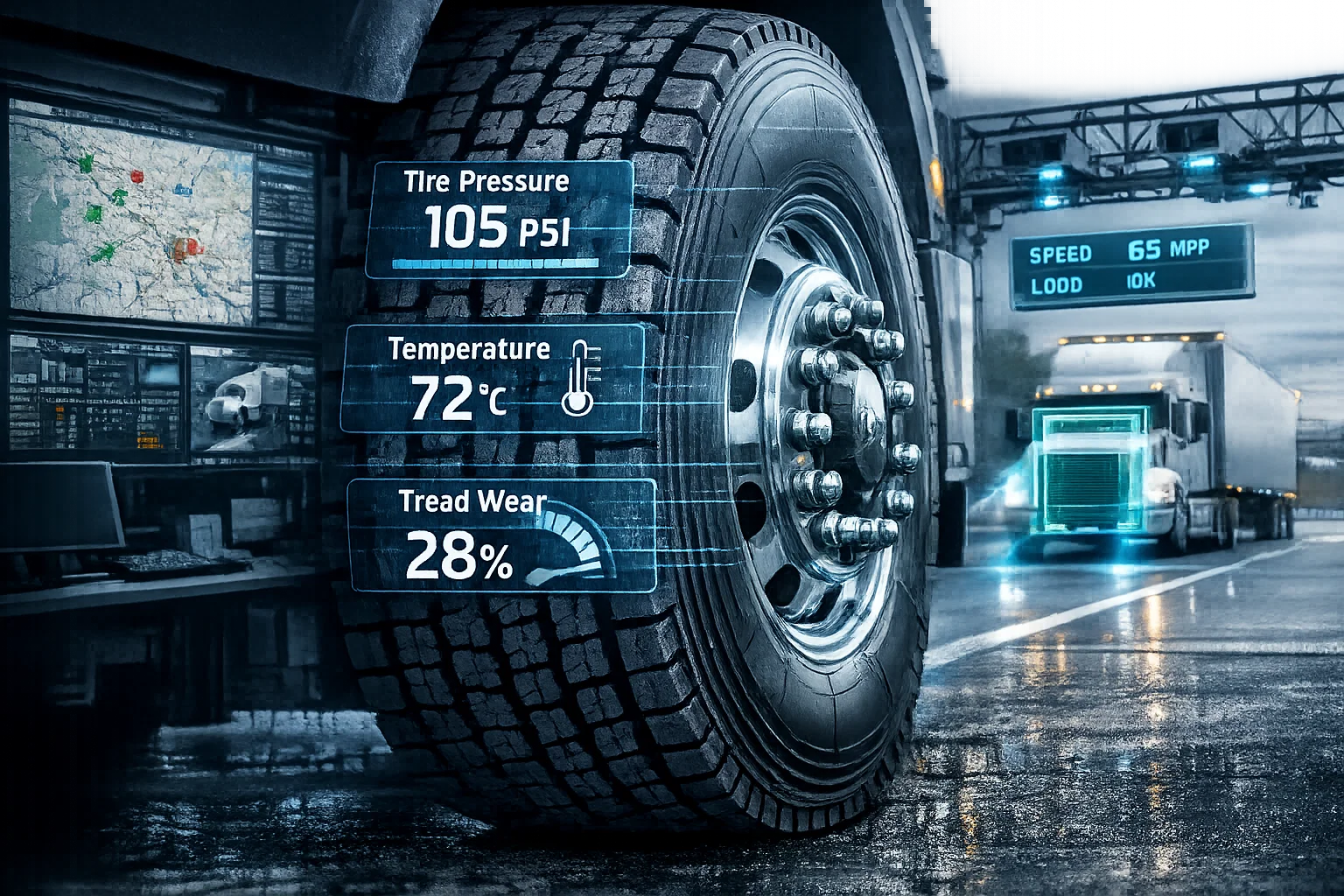
For decades, truck tire competition has sounded familiar: tread life, traction, casing durability, price. Yet the last 48 hours of public information suggests a different framing—one that treats the truck tire not only as a product but as a permanent sensor position at the only place where the vehicle touches the road. On January 12, a GlobeNewswire release summarizing Research and Markets’ “Tyre Manufacturers’ Telematics Activities” research note stated that tire manufacturers are increasingly capitalizing on fleet management solutions and integrating tire pressure systems with telematics to provide real-time data and alerts. It also described how many major tire makers offer TPMS solutions that can be integrated with third-party telematics platforms, allowing fleet managers to monitor inflation pressure and temperature and receive alerts. One day later, a January 13 PRNewswire release described a highly practical workflow layer: AI-driven drive-thru inspection can detect tire issues such as low tread depth, uneven wear, mismatched tires, or sidewall damage, and then connect those findings to live, store-specific quoting and availability with a single click—reducing manual input and compressing time from detection to action. Together, these updates hint at a new basis of value for truck tires: fleets don’t just buy rubber; they buy predictability—fewer surprises, fewer roadside events, and tighter control over operating cost volatility.Why fleets pay for “tire digitalization”: downtime costs dwarf tire costs—and unpredictability is the real enemy
In trucking, the hardest problem isn’t that costs are high—it’s that they are unstable. Tires are a perfect example. Two fleets can run similar routes and loads, yet one experiences calm, planned replacements while the other gets hit by irregular failures that trigger towing, emergency labor, missed appointments, substitute equipment, and reputational damage. Fleet managers don’t fear the act of replacing a tire; they fear the chain reaction created by an unplanned tire event. That’s why the January 12 research summary matters: it explicitly frames tire pressure monitoring systems and telematics integration as a way to deliver real-time pressure and temperature visibility and alerts—shifting tire management from reactive to proactive. Meanwhile, the January 13 PRNewswire release describes how automated inspection identifies concrete tire issues—low tread depth, uneven wear, mismatched tires, sidewall damage—and then lets service teams move directly into accurate, inventory-reflecting quotes without manual data entry. In fleet terms, that means risk is no longer trapped as an “after-the-fact expense.” Risk becomes something that can be observed early, priced quickly, scheduled into a maintenance window, and absorbed into a plan rather than a crisis.Why tire makers are moving into fleet telematics: it’s not a random pivot—it’s the most complementary extension of their core business
The January 12 research summary makes the complementarity argument directly: the tire industry has found fleet management highly complementary to its core business, and major tire manufacturers offer TPMS solutions that are often integrated with third-party telematics platforms. This integration enables fleet managers to view live inflation pressure and temperature data and receive real-time alerts. That complementarity is intuitive: the tire sits at the intersection of safety, energy consumption, wear behavior, load cycles, and driver inputs. When fleets can continuously observe tire health, the tire stops being a “black box” and becomes a measurable operating variable. The same January 12 release also states that some major manufacturers have built their own fleet management offerings, largely driven by M&A activity, and it provides notable connected vehicle scale examples—Bridgestone Mobility Solutions around 1.3 million connected vehicles and MICHELIN Connected Fleet over 0.7 million vehicles. For truck tire companies, the strategic implication is significant: the value proposition shifts from “we sell you tires” to “we help stabilize your operating outcomes,” and that is a stronger story for large fleets than incremental product claims alone.From TPMS alerts to automated inspections: tire management is evolving from “spot warnings” to an end-to-end workflow
Traditional TPMS is often perceived as an alarm—something that triggers when pressure or temperature deviates. Useful, but incomplete. Fleets increasingly want a complete chain from identification to resolution. The January 13 PRNewswire release illustrates what that chain can look like in practice: drive-thru scanners detect tire issues (low tread depth, uneven wear, mismatched tires, sidewall damage), and service advisors can click next to the inspection results to launch an OEM-branded Tire Rack Wholesale portal with relevant details pre-filled—then receive live dealer pricing and availability. This matters for truck tires because fleet operations are built around constrained maintenance capacity. The faster a tire issue is validated and converted into an actionable plan—specific fitment, known availability, transparent price—the more likely it is the fleet can schedule work before the issue becomes downtime. The January 12 release provides the upstream context: tire makers are actively integrating tire pressure systems with telematics to improve real-time data and alerting. Combine real-time monitoring with automated detection and you get something fleets have been chasing for years: a consistent, auditable workflow rather than a patchwork of human judgment.One-click quoting looks like retail efficiency—but for truck tires it’s supply-chain efficiency, because reducing waiting reduces downtime
At first glance, instant quoting sounds like a dealership sales acceleration story. For truck tires, it is more than that. Commercial tire replacement is tightly coupled to dispatch schedules, driver hours, compliance checks, and shop capacity. Waiting—waiting for an accurate fitment, waiting for price confirmation, waiting for inventory validation—often becomes the hidden driver of downtime. The January 13 PRNewswire release explicitly positions the integration as moving “from tire detection to quote in one click,” producing quotes that reflect real, in-stock tires and removing manual data entry. In fleet terms, that means the moment a tire problem is found, the organization can also immediately see what solutions are realistically available and what they cost, which enables earlier scheduling and fewer last-minute disruptions. The January 12 release strengthens the argument by describing the industry’s push to integrate TPMS with telematics for live pressure/temperature data and alerts—so problems are found earlier, and the system can support faster action. This is the operational logic of the coming truck tire market: the winner isn’t only the tire with strong specs; it’s the provider that compresses time-to-decision and time-to-fix.The M&A and partnership logic: whoever owns tire health data sits closer to the fleet’s decision center
The January 12 research summary highlights how tire manufacturers expand their digital offerings through M&A-driven telematics and services integration, and notes that some players pursue partnerships and integration with existing telematics systems. It also forecasts continued development, with additional tire players expected to expand their activities through acquisitions or partnership strategies. For truck tire companies, this is not merely “tech adoption.” It is a shift in where influence sits. Historically, tire choice could be dominated by unit price and warranty. But if tire health data is continuously integrated into fleet operations, tire selection becomes an earlier-stage decision that includes service architecture, alerting quality, workflow speed, and data compatibility. The January 13 PRNewswire release illustrates a lighter entry route: start by connecting detection to quoting and availability, turning tire health signals into immediate commercial action. Whether through large-scale M&A or practical integration, the strategic aim is similar: move from being a vendor at procurement time to being a partner in day-to-day operational decisions.Feedback into R&D: as data flows back, “good tire performance” will be defined by real duty-cycle curves, not brochure claims
When TPMS integrates with telematics and fleets can observe real-time pressure and temperature, the industry gains a consistent stream of real-world operating signals. The January 12 release explicitly discusses these integrations and real-time alerting as part of tire makers’ connected services initiatives. The implications for truck tire R&D are profound. Instead of relying on limited test regimes and periodic field feedback, tire makers can better understand how pressure behavior, temperature rise, and wear outcomes correlate with route types, loads, and operating habits. Meanwhile, the January 13 PRNewswire release adds another dimension: automated inspection can detect and classify visible tire issues such as low tread depth, uneven wear, mismatched tires, and sidewall damage. That classification effectively creates “labels” that can be connected back to operating data, enabling stronger root-cause insights. Over time, this pushes tire design and service design to co-evolve: tires become easier to monitor and diagnose, and service workflows become more consistent, turning performance from a promise into a measurable curve that fleets can trust.Immediate fleet benefits: tire budgets become forecastable, and safety becomes a process rather than a slogan
Fleet budgeting often fails when unexpected tire events cluster—sudden spikes in uneven wear, sidewall damage, or premature tread depletion can turn a controlled plan into a scramble. The January 12 release underscores the value of live pressure/temperature visibility and real-time alerts enabled by TPMS integration with telematics. That visibility helps fleets move tire health into routine management—weekly KPIs, exception reporting, scheduled interventions—rather than post-incident reviews. The January 13 PRNewswire release addresses the other half of the equation: after identifying issues, the system quickly produces accurate, inventory-specific quotes, reducing friction in turning diagnosis into action. For truck tires, safety and cost are rarely opposing goals. Many major failures present early warning signs—pressure issues, abnormal wear patterns, or visible damage. When a fleet can detect earlier and resolve faster, safety improves and cost volatility falls. That’s why the future of truck tires is inseparable from workflow: the product, the data, and the service channel must operate as one system.What truck tire manufacturers should do now: build a delivery system that unites product, data, and service
The last 48 hours’ signals are not a call to chase buzzwords; they are a practical blueprint. First, at the product level, design for stable behavior under monitored conditions—tires that deliver consistent outcomes when fleets can observe and manage them. Second, at the data level, ensure integration readiness: the January 12 release makes clear that TPMS-to-telematics integration and real-time alerting are becoming mainstream expectations, and that tire manufacturers are actively participating in that ecosystem. Third, at the service level, compress the “detect → decide → deploy” cycle: the January 13 release shows how automated detection plus one-click quoting and live availability reduces manual work and speeds resolution. When these three pillars combine, competition shifts away from the procurement moment and into everyday operations—each dispatch, each alert, each maintenance slot decision. The tire maker that reduces uncertainty will win loyalty, not just the tire maker that lowers invoices.Closing: in 2026, the most valuable truck tire feature is predictability—because uncertainty is what drains fleet cash flow
Taken together, the January 12 industry research summary and the January 13 workflow announcement tell the same story: the tire industry is embedding “tire health” into connected services and operational workflows. TPMS integration with telematics enables live visibility and alerts; automated inspection can identify issues; integrated quoting and availability can turn detection into immediate action. For truck tire companies, tread life will always matter—but the next era belongs to those who can make performance predictable, anomalies visible early, and solutions executable fast. In trucking, the most expensive thing is rarely the tire itself. It is the surprise.
Copyright © 2024-2025 Firemax Sdn. Bhd Company. All rights reserved.
Headquarters address:303 block C, Pusat Dagangan Phileo Damansara 1, No 9 Jln 16/11 Off Jalan Damansara, 46350 Petaling Jaya, Selangor. Malaysia Sales Hotline:+60 11-6449 0688 After-sales hotline:+60 11-6449 0688